Discover how traditional Vedic astrology combines birth-chart analysis, Vimshottari Dasha, Navamsa and planetary transits to identify potential marriage periods.
Marriage is one of life's most significant milestones. Questions about when marriage might happen, what kind of partner one might meet, and which periods may be favorable have been part of Vedic astrology for centuries.
At AstroPinch, our approach brings together traditional Vedic astrological principles and structured computational logic to analyze marriage-related indications and identify potential timing windows.
Rather than relying on a single planetary placement, the AstroPinch Astrology Engine evaluates multiple factors, including the seventh house, the Navamsa chart, planetary periods and transits.
Let's explore how this process works.
1. Understanding the Astrological Foundations of Marriage
In Vedic astrology, marriage is primarily assessed through the seventh house of the birth chart, also known as the Kalatra Bhava.
However, a comprehensive interpretation considers several houses and planetary significators together.
| Astrological Factor | Traditional Significance |
|---|---|
| Seventh house | Marriage, spouse and partnership |
| Seventh-house lord | Condition and activation of partnership-related themes |
| Second house | Family formation and continuity |
| Eleventh house | Fulfillment of desires and gains |
| Fifth house | Romance, attraction and courtship |
| Venus | Love, attraction and relationship harmony |
| Jupiter | Wisdom, guidance and traditional marriage-related significations |
| D9 Navamsa | Supplementary assessment of marriage-related themes |
These factors do not carry identical significance in every chart. Their interpretation depends on planetary placement, house lordship, aspects and relationships between the relevant planets.
The objective is to interpret the birth chart as a whole rather than make predictions from isolated combinations.
2. The Importance of the D1 Birth Chart
The D1, or Rashi chart, is the starting point for marriage analysis.
The engine evaluates the seventh house, its ruling planet, planets occupying the house and significant planetary relationships.
It also examines supporting houses and relevant natural significators.
For example, an astrologer might interpret a favorable connection between the seventh lord and other marriage-related factors as supportive of partnership themes.
Conversely, challenging configurations might be interpreted as indicating obstacles or the need for greater maturity in relationships.
Neither interpretation independently establishes whether or when a person will marry.
3. How the Navamsa Chart Refines Marriage Analysis
The D9 Navamsa is an important divisional chart in traditional Vedic astrology.
AstroPinch uses it as a supplementary layer of interpretation alongside the D1 chart.
The analysis may consider:
- The D9 seventh house and its lord.
- The placement and condition of Venus.
- Relevant planetary relationships.
- Connections between D1 and D9 indicators.
- Supporting and conflicting indications across the charts.
The purpose is to develop a more complete traditional interpretation.
The Navamsa should not be treated as an independent guarantee that a marriage indicated by another chart will occur. Its conclusions must be interpreted in context.
4. Vimshottari Dasha: Identifying Potential Marriage Periods
One of the central components of the AstroPinch timing engine is Vimshottari Dasha.
This traditional system divides planetary periods into Mahadasha, Antardasha and Pratyantardasha.
The starting period and its remaining duration are calculated using the Moon's birth Nakshatra.
The engine then identifies upcoming periods involving planets that have relevant connections with marriage-related factors in the birth chart.
These may include the seventh lord, planets occupying the seventh house, Venus and other appropriately connected planets.
The process involves three stages:
- Mahadasha analysis: Identifies the broader planetary period.
- Antardasha analysis: Examines the sub-period for additional marriage-related indications.
- Pratyantardasha analysis: Provides a finer level of timing interpretation.
The resulting periods become candidates for further assessment.
A relevant Dasha does not, by itself, establish that marriage will occur. It is one component of the complete timing analysis.
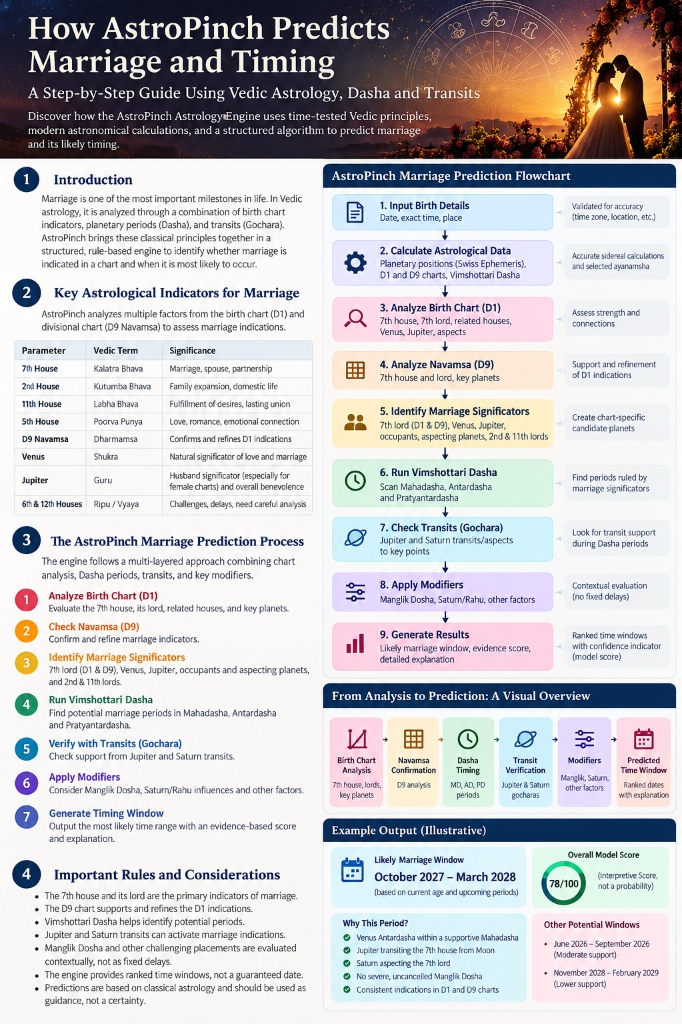
Figure 1: The AstroPinch Marriage Prediction Process — from astronomical inputs and D1/D9 analysis to Vimshottari Dasha, Gochara transits, and explainable model scoring.
5. Double Transit: Evaluating Jupiter and Saturn
In some Vedic astrology approaches, Jupiter and Saturn transits are used to refine event timing.
Jupiter is traditionally associated with expansion, growth and guidance, while Saturn is associated with responsibility, structure and maturity.
AstroPinch can evaluate whether their transits support a candidate period identified through Dasha analysis.
Depending on the configured astrological rules, the engine may examine transits or aspects involving:
- The seventh house.
- The seventh-house lord.
- The Ascendant.
- The Moon.
- Venus and other relevant natal positions.
These conditions provide additional interpretive context.
However, simultaneous Jupiter and Saturn activation should not be treated as a universal requirement for marriage. Different astrological traditions use different transit rules.
AstroPinch therefore treats transit support as an additional factor rather than an infallible confirmation.
6. Evaluating Manglik Dosha and Other Modifiers
Manglik Dosha, Saturn's relationship with the seventh house, and other planetary configurations are frequently considered in traditional marriage analysis.
AstroPinch should evaluate these factors contextually.
For Manglik Dosha, this involves examining Mars's placement and the applicable cancellation or mitigation rules within the selected Vedic astrology framework.
The system should distinguish between the presence of a traditional Dosha indicator and the interpretation of its potential significance.
Similarly, Saturn or Rahu in the seventh house should not automatically be interpreted as a fixed marriage delay.
No planetary placement should trigger an arbitrary two-year postponement or guarantee marriage after a particular age.
Instead, the engine should record relevant indicators, evaluate the wider chart and explain the reasoning behind its interpretation.
7. How AstroPinch Generates a Marriage Timing Window
The engine brings together the results of its different analytical stages.
The process can be summarized as follows:
Each candidate period is evaluated against the selected astrological rules.
A period with stronger supporting indications may receive a higher internal priority than a period with fewer supporting factors.
The system can then produce a report explaining:
- Which candidate period has the strongest traditional astrological support.
- Which Dasha and transit factors contribute to the interpretation.
- Which supporting or challenging indicators were identified.
- Why another period received a lower priority.
- What limitations affect the interpretation.
This makes the result more transparent than a prediction based on a single planetary combination.
8. What Does the Confidence Score Mean?
A prediction engine may use numerical scores to organize and compare candidate periods.
However, an important distinction must be maintained between an internal model score and a statistically validated probability.
For example, a timing alignment score of 80 out of 100 could indicate that a candidate period satisfies many of the engine's predefined astrological rules.
It does not mean that there is an 80% probability of marriage during that period.
To report actual predictive probabilities, AstroPinch would need to evaluate historical predictions against real-world outcomes and demonstrate that its probability estimates are appropriately calibrated.
Until such validation exists, numerical scores should be described as interpretive indicators rather than probabilities of marriage.
9. Can Vedic Astrology Predict the Exact Date of Marriage?
Vedic astrology offers traditional methods for identifying potentially favorable periods, but it cannot scientifically guarantee the exact date of an individual's marriage.
The accuracy of any prediction depends on the reliability of the birth information, the consistency of the calculations and the interpretive rules applied.
Actual marriage also depends on personal decisions, relationships, circumstances and opportunities that a birth chart cannot establish with certainty.
For this reason, AstroPinch should present candidate windows with explanations and appropriate uncertainty rather than promise a guaranteed marriage date.
10. The AstroPinch Approach: Traditional Wisdom with Structured Analysis
The AstroPinch Marriage Prediction Engine is designed around a simple principle: a comprehensive astrological interpretation should consider multiple factors together.
By combining D1 analysis, D9 assessment, Vimshottari Dasha and selected transit rules, the system can generate structured marriage-related interpretations and rank potential timing windows.
Its value lies in making the reasoning consistent, transparent and explainable.
The next step in improving the engine is systematic validation: comparing its predictions with historical outcomes, testing alternative rules and measuring whether particular combinations provide useful predictive information.
This distinction between traditional interpretation and demonstrated predictive performance is essential for responsible astrology technology.
Conclusion
Marriage prediction in Vedic astrology is a multi-layered process rather than a single planetary calculation.
AstroPinch brings together traditional astrological concepts in a structured engine that evaluates marriage indicators, identifies candidate timing periods and explains the factors behind its conclusions.
The goal is not to promise certainty, but to provide users with a clear, thoughtful and transparent astrological interpretation.
AstroPinch — Exploring life's possibilities through Vedic astrology and intelligent analysis.