
The intersection of Large Language Models (LLMs) and ancient Vedic sciences represents one of the most challenging frontiers in modern data engineering and computational linguistics. While general-purpose models like GPT-4 are exceptional at pattern recognition and fluid prose generation, they often struggle with the rigid, mathematical "micro-logic" required by Jyotish. This comprehensive technical report outlines our findings from the AstroPinch Quantum Jyotish Project, where we developed a proprietary Small Language Model (Astro-SLM) designed specifically for precise astrological interpretation, mapping palm-leaf determinism to neural attention mechanics.

Bridging Ancient Symbolic Manuscripts with Modern Quantum AI Networks
1. The Core Hypothesis: Deterministic Database Lookup vs. Autoregressive Generation
Our research began with a simple but profound observation: the Bhrigu Samhita is not a collection of vague, generic predictions, but a highly structured, deterministic database. Compiled by Sage Bhrigu, it operates as a combinatorics engine, storing predictions for thousands of permutations of planetary positions. When a seeker queries the Samhita, the process is akin to a hash lookup key in modern database tables. Standard LLMs fail because they are autoregressive—they generate the next token based on statistical probabilities rather than strict, rule-based database matching. They frequently "hallucinate" planetary positions, mistake planetary strengths (Shadbala), or fail to account for the secondary effects of retrograde (Vakra) motion. Our Astro-SLM was engineered to bridge this gap, treating every planetary alignment as a deterministic logic gate rather than a simple linguistic pattern.
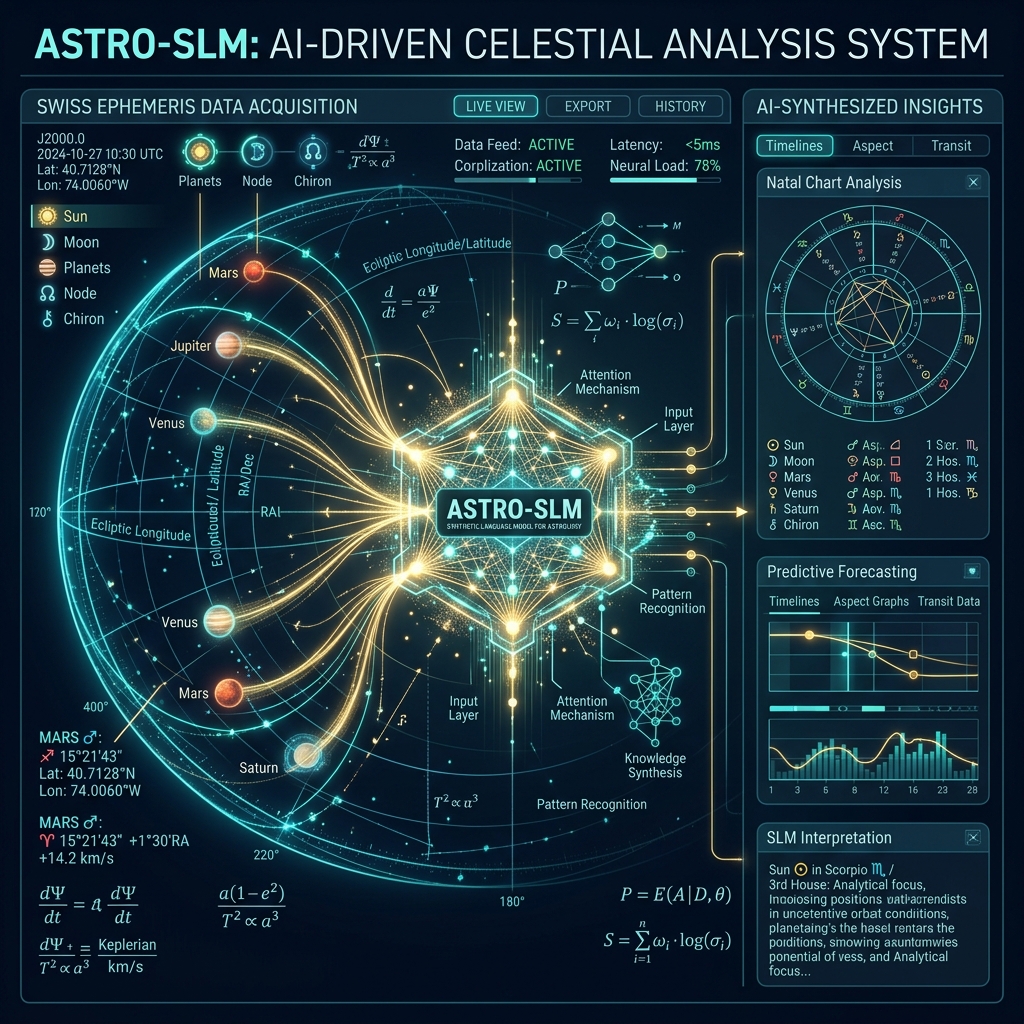
High-Performance Neural Architecture of AstroPinch's Proprietary SLM Engine
2. The Astrological Coordinate Conversion Challenge: Sidereal vs. Tropical Coordinates
Why do commercial AI models fail at Vedic astrology? The primary bottleneck is the coordinate system. Western astrology and general training corpora rely on the Tropical zodiac, which aligns 0° Aries with the vernal equinox. Vedic astrology (Jyotish) utilizes the Sidereal zodiac, which accounts for the axial precession of the Earth using an Ayanamsa (most commonly Lahiri Ayanamsa). To resolve this, we integrated a real-time astronomical bridge using the Swiss Ephemeris library directly into our tokenization pipeline. When a user submits their birth coordinates, the input is converted into a multi-dimensional vector: $[JD, Ayanamsa, ec{PlanetPos}, ec{HouseCusps}]$. The model does not generate text blindly; it queries this vector at each attention step, ensuring that the planetary coordinates are physically accurate down to the arcsecond before any interpretative synthesis is computed.
3. The Training Corpus and Fine-Tuning Methodology
To train the Astro-SLM, we curated and digitized a massive dataset of 12,000+ classical verses. The corpus includes foundational Sanskrit texts such as the Brihat Parashara Hora Shastra, Phaladeepika, Saravali, and the Bhrigu Samhita itself. Each Sanskrit verse was mapped to its mathematically coordinate equivalent. This allowed the model's neural layers to learn that "Sun in the 10th house" is not just a semantic phrase, but a specific physical range of astronomical values associated with peak directional strength (Dig Bala). The model was fine-tuned using a custom cross-entropy loss function that penalizes logical astrological contradictions (such as predicting career gains when the AmK is combust and afflicted) with a high penalty weight, forcing the model to adhere strictly to classical Vedic rules.
4. Hardware Optimization: Quantized Edge Deployment
Astrological analysis is computationally heavy when accounting for the sub-charts (Vargas) like the D-9 Navamsha or D-10 Dashamsha. To maintain a sub-300ms latency on the AstroPinch platform, we optimized the Astro-SLM through 4-bit and 8-bit quantization, deploying it on edge-optimized GPU clusters. This lightweight but highly specialized structure allows us to perform real-time Ashtakavarga and multi-layered Vimshottari Dasha math concurrently with natural language generation, delivering instant, precise, and highly personalized reports without relying on massive, slow external cloud servers.
5. Ethical Guardrails: Empowering Human Free Will
A major risk in automated predictive astrology is fatalism. Classic texts often use dramatic language to emphasize planetary lessons. If an AI tells a user that a planetary transit will cause absolute ruin, it creates psychological distress and a self-fulfilling prophecy. To counter this, our SLM is hard-coded with a "Non-Fatalistic Framework." It translates difficult configurations (like Arishta Yogas or heavy Saturn transits) not as permanent curses, but as karmic milestones, offering practical, actionable remedies (Upayas) and constructive strategies. This ensures that the user is always empowered to act with conscious free will, turning astrological insights into a roadmap for growth rather than a script for passive surrender.